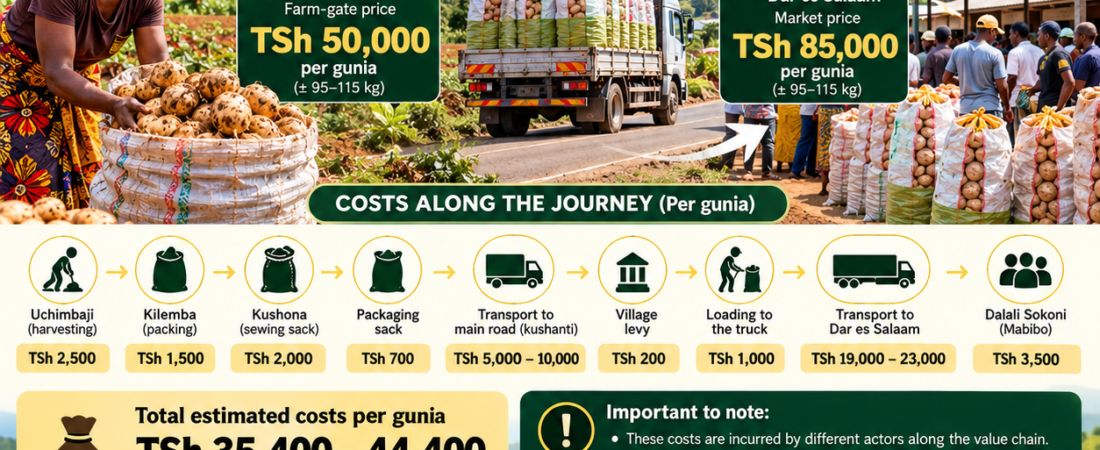
A gunia of Irish potatoes sells for a reported TSh 50,000 in Lugarawa, Ludewa. At Mabibo Market in Dar es Salaam, a comparable gunia weighing approximately 95–115 kg is reported to sell for TSh 85,000.
The apparent difference is TSh 35,000 per gunia.
But what happens between these two points?
Let us examine the costs involved in moving potatoes from the farm to the market.
The cost of the journey
Based on the figures reported to Kambeta Farms, the journey may involve:
- Uchimbaji (harvesting): TSh 2,500
- Kilemba packing: TSh 1,500
- Kushona (sewing the sack): TSh 2,000
- Packaging sack: TSh 700
- Transport from the farm to the main road: TSh 5,000–10,000
- Village levy: TSh 200
- Loading onto the truck: TSh 1,000
- Long-distance transport to Dar es Salaam: TSh 19,000–23,000
- Mabibo market broker (dalali): TSh 3,500
That amounts to TSh 35,400–44,400 per gunia, before allocating the local government levy of TSh 200,000 per truckload.
These are reported costs across the supply chain, not necessarily expenses borne by one person. The local government levy must also be allocated across the number of gunias transported.
And remember: these figures do not include the farmer’s full production costs, such as seed, fertiliser, crop protection, land preparation and field labour. Nor do they capture every possible expense incurred by traders.
The price difference is therefore not automatically profit.
There is another challenge: documenting the journey
Agricultural produce often passes through several hands, with payments for labour, transport, brokerage and local charges occurring at different stages.
In some transactions, formal EFD receipts or other adequate supporting records may not be available.
This creates a practical challenge for businesses trying to demonstrate the true cost of buying and moving produce. It also raises an important question for tax administration: how can legitimate agricultural expenditure be properly documented and assessed?
This is not simply a question of accounting. It is about building an agricultural trading system in which transactions are transparent, businesses can meet their obligations, and the actual economics of moving food are understood.
What needs to change?
Farmers need better market access. Traders need efficient logistics and workable documentation systems. Buyers need reliable supply and consistent quality. Public institutions need practical approaches that support both compliance and commercially sustainable trade.
At Kambeta Farms, we believe increasing agricultural production is only part of the solution. We farm Irish potatoes and yellow beans while coordinating with farmers to connect production with market demand.
Our ambition is to help build value chains that work better for farmers, traders, buyers and the wider economy.
A question for TRA, agricultural stakeholders, farmers and traders: How can we make agricultural transactions more transparent and properly documented without overlooking the realities of rural markets?