
A practical guide for farmers, produce traders, transporters and potato buyers.
Transport is a critical part of the Irish potato value chain. From farms in Tanzania’s Southern Highlands to collection centres and wholesale markets, choosing the right truck affects transport costs, loading efficiency, produce quality and delivery planning.
But how many sacks can different trucks carry? And does a truck that is physically full necessarily carry a safe and legal load?
This guide explores common truck types used in Tanzania’s Irish potato trade, their typical sack counts and the key considerations when planning transport.
Common Trucks Used for Irish Potato Transport
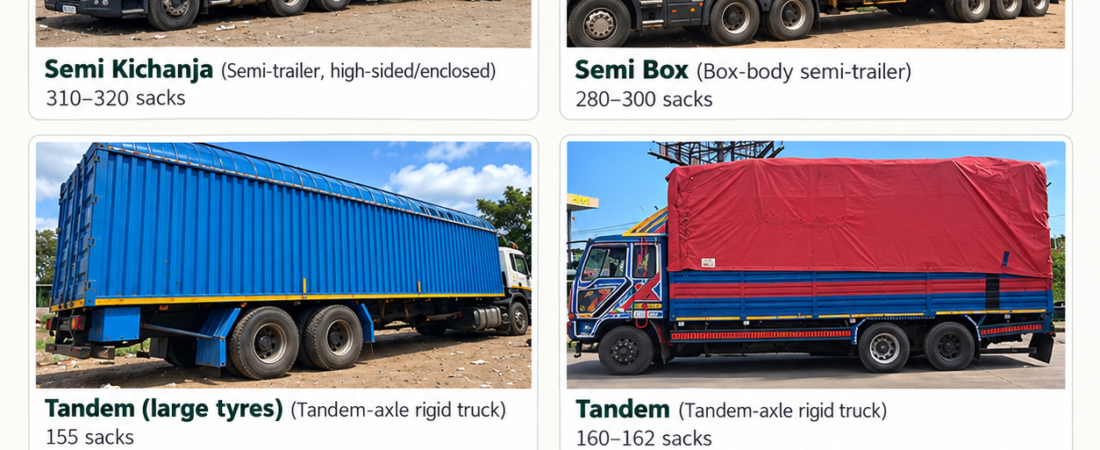
Different truck configurations serve different transport needs. The following table presents typical sack counts based on practical observations of vehicles used in the Tanzanian produce trade.
| Common local name | Typical sacks per trip |
|---|---|
| Fuso | 105–110 |
| Tandem – large tyres (Tandem-axle rigid truck with large tyres) | 155 |
| Tandem – small tyres (Tandem-axle rigid truck) | 160–162 |
| Mende (Three-axle rigid cargo truck) | 190–195 |
| Semi Box (Box-body semi-trailer truck) | 280–300 |
| Semi Kichanja (Semi-trailer truck with a high-sided or enclosed cargo body) | 310–320 |
Refer to the accompanying infographic for photographs of these vehicle types.
These figures are indicative estimates, not certified vehicle capacities. Actual carrying capacity varies with the vehicle’s specifications, cargo-body dimensions, sack weight, loading arrangement and applicable legal limits.
Understanding Sack Weight and the Kilemba
An Irish potato sack may weigh approximately 95–115 kg, depending on potato size, season, packing method and the length of the kilemba—the extra heap of potatoes tied at the top of the sack.
This variation matters when planning transport. A truck that appears physically full may exceed its rated payload once the combined weight of the sacks is calculated.
For example, 100 sacks weighing between 95 kg and 115 kg each represent a potato load of approximately 9.5–11.5 tonnes. The same number of sacks can therefore produce significantly different total loads.
Traders should estimate both the number of sacks and their combined weight before loading.
Why Axle Loads Matter
Consider a Tandem truck carrying 160 sacks of Irish potatoes. If each sack weighs 115 kg, the potatoes alone weigh 18.4 tonnes, excluding the truck and any other cargo.
This illustrates why sack counts alone are insufficient when planning transport. The permitted load depends on the vehicle’s rated Gross Vehicle Mass (GVM), axle configuration, axle-load limits and applicable regulations.
Before dispatch, transporters should verify the vehicle’s permitted payload and ensure that the load is distributed appropriately across its axles. Overloading can increase the risk of vehicle damage, unsafe handling, road damage and penalties at weighbridges.
Remember: The number of sacks a truck can physically accommodate is not necessarily the number it can legally transport.
Protecting Potato Quality During Transport
Irish potatoes can be damaged by rough handling, excessive pressure and poor loading practices. Bruising and other physical injuries can reduce market quality and increase losses during storage and distribution.
Good transport planning should therefore consider more than the maximum number of sacks that fit on a truck.
Key practices include:
- Selecting a vehicle appropriate for the quantity and weight of produce.
- Distributing the load carefully and respecting the vehicle’s rated capacity.
- Handling sacks carefully during loading and unloading.
- Securing the load properly and protecting produce from adverse weather.
- Coordinating collection and delivery to minimise unnecessary delays.
Efficient loading should balance transport economics with produce quality and road safety.
The Kambeta Farms Advantage
At Kambeta Farms, we understand that agricultural logistics involves more than fitting as many sacks as possible onto a truck. Successful market coordination requires the right combination of production planning, aggregation, transport arrangements and access to buyers.
Our approach to agricultural value-chain coordination emphasises matching transport arrangements to the volume of produce, handling requirements, route conditions and applicable vehicle-load limits. From a Fuso to a Semi Kichanja, choosing an appropriate vehicle and organising the load carefully can support more efficient collection and delivery.
By connecting production, aggregation, transport coordination and market access, Kambeta Farms works towards a more organised supply chain that serves farmers and buyers more effectively.
Final Takeaway
Understanding truck types and typical sack counts helps farmers, traders and transporters plan Irish potato movements more efficiently. However, the most suitable vehicle is not always the one that carries the greatest number of sacks.
The best transport decision balances load capacity, total weight, produce quality, road safety and cost.
As Tanzania’s agricultural value chains become more coordinated, practical logistics knowledge can help reduce avoidable losses and improve the movement of produce from farms to markets.
Disclaimer: Sack counts and sack weights in this article are indicative estimates based on practical observations and the stated weight range. They are not certified vehicle specifications or legal payload approvals. Verify vehicle ratings, axle loads and applicable transport regulations before loading.
About Kambeta Farms: Kambeta Farms coordinates agricultural value chains in Tanzania, integrating finance, production and markets for inclusive agricultural growth.