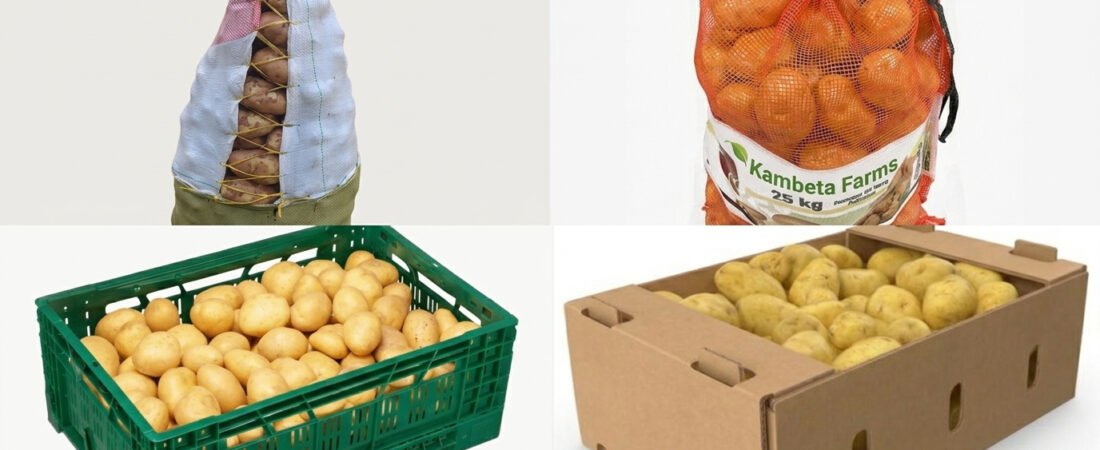
In Tanzania, Irish potatoes are commonly traded in large woven sacks known as gunia or roba, or lumbesa. In many local supply chains, these sacks carry approximately 95–115 kg of potatoes and remain a familiar, practical way to move produce from farms to wholesale markets.
But packaging practices differ across the world. In Ireland and other European markets, potatoes are sold in consumer-sized paper bags, ventilated net packs and larger wholesale sacks. Reusable plastic crates and cartons also serve specific distribution channels.
These differences raise an important question for Tanzania’s potato industry:
Could alternative packaging help farmers, aggregators and buyers improve handling, reduce losses or reach new market segments?
The answer depends on the intended buyer, distribution system, and economics. The objective is not to replace a familiar system without reason, but to understand where alternative packaging creates genuine commercial value.
Understanding the Packaging Formats
A. The traditional Tanzanian gunia/roba

The traditional sack is well established in Tanzania’s potato trade. Its availability, familiarity, and relatively low cost make it practical for bulk transactions.
Advantages
- Widely recognized and familiar to farmers and traders.
- Generally affordable and readily available.
- Compatible with existing wholesale handling practices.
- Allows large quantities to be consolidated into individual packages.
Disadvantages
- Heavy individual units can make manual lifting and unloading difficult.
- Poor filling, dropping and excessive stacking pressure can damage potatoes.
- Variable weights complicate stock reconciliation and price comparisons.
- Product inspection generally requires opening the sack.
- Large sacks may be less convenient for buyers needing smaller quantities.
The traditional sack remains useful, particularly in established wholesale markets. Its limitations become more important when handling practices, worker safety, product damage or buyer requirements become constraints.
B. Smaller ventilated sacks: approximately 10–25 kg
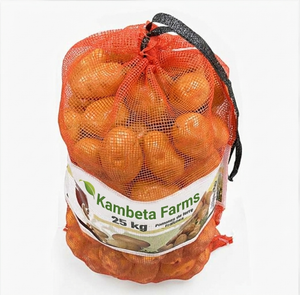
Smaller sacks provide a relatively simple alternative because they retain the flexibility of bag-based handling while reducing the weight of each unit.
International potato supply chains use different sack sizes according to market requirements. Formats around 25 kg are worth investigating for Tanzania’s wholesale and regional distribution channels, subject to buyer confirmation.
Advantages
- Easier individual handling than a 95–115 kg sack.
- More consistent package weights when properly measured.
- Convenient for allocating quantities among multiple buyers.
- May suit regional distribution where buyers prefer smaller units.
Disadvantages
- More bags must be purchased and filled per tonne.
- Additional tying, counting and handling may increase labour costs.
- Smaller bags do not automatically eliminate bruising or compression.
- Commercial benefits depend on whether buyers accept the format.
Potential application: Wholesale customers, regional distributors and buyers who value manageable, standardised quantities.
C. Ventilated corrugated cartons
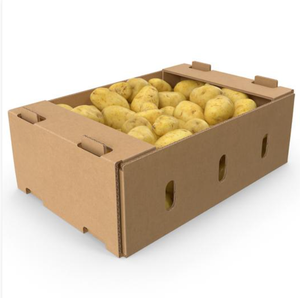
Cartons are used in produce supply chains where defined package sizes, product identification and structured stacking are important. Their suitability depends on the intended market and the carton specification.
Advantages
- Provide a defined package size and space for product information.
- Can improve presentation and facilitate traceability.
- May protect potatoes when designed for the product and handled correctly.
- Can suit selected retailers, catering customers and specialised distribution channels.
Disadvantages
- Usually more expensive than basic woven sacks.
- Moisture can weaken unsuitable cardboard.
- Poor stacking or excessive loading can crush cartons.
- Empty cartons require storage space and add procurement costs.
Potential application: Buyers who require standardised packages, product identification or a more structured distribution system.
Cartons should not be assumed to be the best choice for long-distance transport under all conditions. Their strength, ventilation and resistance to moisture must match the supply chain.
D. Reusable ventilated plastic crates
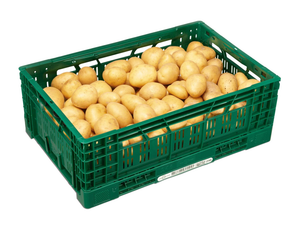
Reusable crates are a different approach to packaging. Rather than using a flexible bag, potatoes are placed in rigid containers that can circulate between suppliers and buyers.
Advantages
- Rigid sides can protect produce against certain handling impacts and compression.
- Stackability can support organised storage and transport.
- Repeated use may spread the purchase cost over many deliveries.
- Can support consistent handling in coordinated distribution networks.
Disadvantages
- Require a higher initial investment.
- Cleaning, storage, losses and return transport add operating costs.
- Unreturned crates can make the system uneconomical.
- Buyers and suppliers need compatible handling arrangements.
Potential application: Regular deliveries to retailers, institutional customers and distribution centres where crates can be returned and reused.
For Kambeta Farms, crates would be worth testing first on a route with a reliable buyer and predictable delivery frequency, rather than distributing them across a fragmented market.
E. Industrial bulk-handling systems
Large-volume buyers may use specialised bulk-handling systems to consolidate produce. Industrial bulk bags are available for some commodities, but not every bag designed for dry goods is appropriate for fresh potatoes.
Advantages
- Can consolidate large volumes into fewer handling units.
- May reduce handling operations where suitable equipment is available.
- Can suit large receivers with compatible loading and unloading systems.
Disadvantages
- Requires compatible equipment and infrastructure.
- Poor ventilation or excessive loading pressure may damage potatoes.
- Initial investment and handling arrangements can be substantial.
- Unsuitable for many ordinary wholesale and retail supply channels.
Potential application: Large-volume receivers and processors, subject to their handling infrastructure and product specifications.
What International Retail Markets Are Doing Differently
International markets demonstrate that packaging can serve purposes beyond moving produce. It can also communicate origin, weight, brand identity, and product information.
In Ireland, for example, some retailers and potato packers have introduced paper-based packaging designed to reduce conventional plastic use. Some formats incorporate net windows for product visibility, while others use cotton or alternative netting materials.
These examples demonstrate three useful approaches.
First, packaging can be matched to the customer. A household buying a small quantity has different requirements from a wholesaler purchasing several tonnes.
Second, packaging can communicate product identity. Defined weights, clear labelling, origin information and traceability can help distinguish one supplier’s produce from another’s.
Third, sustainability must be assessed across the whole system. Paper packaging is not automatically superior in every application. Moisture resistance, durability, material sourcing, recycling infrastructure and total cost all matter.
For Tanzania, the lesson is not to copy European retail packaging wholesale. It is to identify which features could create value for local and regional buyers.
Packaging and Market Positioning
Packaging can help suppliers serve different market segments.
| Market segment | Formats worth investigating | Main consideration |
| Farm-gate and traditional wholesale | Existing gunia/roba | Availability and bulk-handling economics |
| Wholesale and regional distribution | Smaller ventilated sacks | Handling, standard weights and cost per tonne |
| Retail and selected catering customers | Smaller bags or cartons | Presentation, convenience and buyer specifications |
| Repeated organised deliveries | Reusable ventilated crates | Reuse frequency and return logistics |
| Large-volume receivers | Specialised bulk-handling systems | Equipment compatibility and product protection |
These are potential applications, not universal rules. Actual requirements must be confirmed with individual buyers.
For suppliers targeting formal retail or export markets, packaging may also need to support accurate net-weight declarations, product identification, traceability and applicable labelling requirements.
Where regulated packaging materials, food-contact materials or export documentation are involved, the relevant destination-market standards must be checked before adoption.
The Commercial Comparison: Which Package Makes Economic Sense?
A package should not be selected merely because it looks better or is common in another country.
The more useful question is whether it improves the economics of delivering saleable potatoes to the buyer.
Consider five indicators:
- Packaging cost per tonne: How much does the packaging itself cost for a tonne of potatoes?
- Labour cost: How much time is required for filling, loading, unloading and counting?
- Product damage: Does the package reduce bruising, crushing, rejection or other losses?
- Transport efficiency: How effectively does the format use truck capacity and available space?
- Buyer acceptance: Does the buyer prefer or require the format, and is there any additional revenue to justify its cost?
For reusable crates, include cleaning, storage, loss rates and return transport. For cartons, consider moisture exposure, stacking strength and disposal or recycling arrangements.
A smaller sack may reduce the difficulty of handling individual units but increase the number of bags required per tonne. A crate may offer better physical protection but become expensive if it is not returned. A carton may improve presentation without necessarily generating a higher selling price.
The best packaging is the format that performs well across the supply chain, not necessarily the one with the lowest unit price.
What Should Tanzania Test First?
A practical first step is to compare the traditional gunia/roba with a smaller ventilated sack, such as a 25 kg format.
A second trial could examine reusable crates on a regular delivery route involving a buyer willing to participate in a return system.
The trial should measure:
- Packaging cost per tonne.
- Filling and loading time.
- Labour required per tonne.
- Transport cost and truck utilisation.
- Product damage and rejection rates.
- Buyer acceptance and willingness to continue using the format.
Trials should compare equivalent potato grades and similar transport conditions wherever possible. Otherwise, differences in product quality, distance or handling could distort the results.
The findings would help determine whether a packaging change offers a measurable advantage before larger investments are made.
What This Means for Kambeta Farms
Kambeta Farms is developing a more coordinated agricultural supply system centred on farmers, production planning, aggregation and market access, with a current focus on Irish potatoes and yellow beans.
Packaging is one of the practical decisions that connects production to the final buyer.
As we develop relationships with wholesalers, retailers, institutional customers and other commercial buyers, understanding their preferred package sizes and handling systems can help inform aggregation and delivery decisions.
The objective is not to introduce expensive packaging without a clear commercial reason. It is to identify formats that protect produce, meet buyer requirements and improve supply-chain efficiency.
For farmers and aggregators, that means asking buyers about package sizes, net weights, handling preferences and delivery requirements before making substantial packaging investments.
Conclusion: Better Packaging Should Deliver Better Commercial Outcomes
The traditional gunia/roba remains an important part of Tanzania’s potato trade. Its familiarity, availability and established role in wholesale markets are real advantages.
However, smaller ventilated sacks, cartons, reusable crates and specialised bulk-handling systems provide alternatives worth evaluating for specific commercial applications.
International experience shows that packaging can support not only transportation, but also product presentation, traceability, convenience and market differentiation.
For Tanzania, the opportunity is to combine the strengths of the existing trade with carefully tested alternatives that suit local operating conditions and buyer requirements.
At Kambeta Farms, we believe stronger agricultural value chains are built by understanding not only what the market wants to buy, but also how the product should reach the market.
Quality African Produce. Supplying Africa and Beyond.